A Moment in the History of Space Science: coverage at ESOF2022 and my thoughts now.

On July 12th, 2022, NASA (The U.S. National Aeronautics and Space Administration) released the first full-colour images from the James Webb Space Telescope (JWST).

The very next day the EuroScience Open Forum ran sessions at ESOF2022 to enable further explanation of the images, and to provide an understanding of the history of the JWST including the many different challenges and difficulties that had been successfully overcome. Sessions continued in Leiden and on-line throughout the week to enable questions, discussions, and debate amongst a wide range of scientists, politicians, and the public. Experts including astronomers, engineers, and other scientists were on hand to provide explanations of the science and the significance.

The excitement and enthusiasm were palpable. The speakers and discussions were inspirational to younger researchers, budding astronomers and more generally of course.

It was fitting to hold these sessions during ESOF2022 because in addition to the major role of NASA the success of this significant breakthrough was also a result of extensive international collaboration in which the ESA (European Space Agency) had a major involvement. *

I learned a lot about space science at ESOF2022 and I also realised how much I didn’t know. My curiosity was sparked, and this motivated me subsequently to go and find out more from other sources as well.

I would like to share some of my learning with you:

A few key points

The JWST enables us to look further back in time than ever before.

The reason why the JWST has been likened to a time-machine that lets us see into the past is that when looking at very distant objects we see them as they were in the past because the light takes time to reach us.

Infra-red (IR) astronomy is the key ‘game-changer’ to enable this breakthrough.

We were previously unable to see earlier galaxies and further back because they were invisible to us. Light that was emitted more than 13.5 billion years ago would be ‘stretched out’ finally arriving here as infra-red light.

Some of the science, engineering, and technological development involved

The JWST team had to put this large IR telescope into space because IR light is absorbed by water and our atmosphere is full of water.

An IR telescope needs to be cold; it is very sensitive to tiny amounts of heat. Therefore, the telescope needed to be a long distance from the Earth. However, it would then be in direct ‘line of fire’ of the Sun which is a massive source of heat.

A major challenge was that something had to be invented that would keep the telescope cold and ‘never let it see the Sun’. The solution was the invention of a unique mirror (6.5 meters in diameter) and ‘a sunshield the size of a tennis court’. This mirror had to be built on the ground to test that it would work. Both the mirror and sunshade needed to be folded up to be transported and to subsequently be unfolded far away in outer space.

Programme and project management

From my own experience in projects and consultancy (albeit not on this scale and in different areas) I am sure there will have been many challenges and learning to be taken forward from this large international, collaborative, inter-disciplinary programme. Important aspects would have included teamwork, leadership, planning and monitoring not to mention the politics and funding challenges that needed to be managed along the way.

I’d like to highlight the following points that immediately strike me regarding JWST:

1. The need for persistence: The story behind this programme sends a message of the power of persistence which led to ultimate success despite many challenges and setbacks on the way.

2. The importance of risk management. Attention to detail is key, for example what might seem like the smallest human error can affect the success of the whole project.

I also think this success story brings a message of hope to other individuals and groups when facing setbacks; emphasising the immense value of taking the learning forward when things go wrong or not exactly to plan.

Concluding remarks:

The JWST programme is great example of what can be done in science with collaboration, persistence, and support.

Big collaborative projects can work well and achieve enormous advances.

The JWST success sparks curiosity and prompts other questions to explore for example questions regarding the birth of stars, and even whether there is Life beyond Earth…

The world is watching this space for further discoveries to come (pun intended 😉).

Finally, it is very exciting because we are going to discover and see things we have never seen before!

by Dr Julie Charlesworth 27/01/23

_________

*The U.S. National Aeronautics and Space Administration (NASA) led JWST’s design and development and partnered with two main agencies: the European Space Agency (ESA) and the Canadian Space Agency (CSA).

Post Script. Here I share my perspective of this ‘out of this world’ news. I’ll soon be back in more familiar territory – Life Sciences and related 🧬, clinical and health research which I find equally exciting. However, as the new year begins it seems particularly timely to have a quick look back and even beyond 😊 🚀.

_________

At the EuroScience Open Forum in 2022 (ESOF2022)
Thoughts on Artificial Intelligence (AI).

Here are some of my thoughts just now on Artificial Intelligence (AI) generally.

The increasing use of AI can be a bit ‘mind-boggling’.

There is clearly an important and potentially valuable role for AI in many science and medical fields, and aspects of life in general. There is a great deal written about this subject elsewhere.

At the EuroScience Open Forum in 2022 (ESOF2022) there were some interesting discussions on dilemmas about AI in science and society. In some of the discussions I picked up on a couple of phrases and opinions which I found thought provoking:

• A suggestion that AI would be better called ‘augmented computation’.

• A suggestion (in July 2022) that when compared with human capabilities in some respects, for example in publishing, AI could be considered at the level of ‘the gifted toddler’. However, capabilities do seem to be rapidly increasing and this is resulting in current debate and news coverage.

• It is concerning that in some instances with the use of AI there are dangers of asking a system to do something that it is not designed to do, and also potentially locking in prejudices that are not transparent or immediately obvious to others.

It strikes me that AI is here to stay, and with it there is great potential for it to be used for the benefit of humankind. We are already reaping benefits. We should however be aware of the possible hype around the value and capabilities of AI.

There are reasons to proceed with optimism, but also with caution and with ‘eyes wide open’.

by Dr Julie Charlesworth 16/01/23

.

At the EuroScience Open Forum in 2022 (ESOF2022)
Looking Beyond in the lull before the New Year.

By looking beyond, I find I am often better able to understand and communicate what is in front of me. This could be my mantra 😊😉.

I am just popping in here to wish you well in this quiet period – the lull before the New Year.

by Dr Julie Charlesworth 27/12/22

.

[NB. I will shortly be sharing some thoughts and posts on some ‘beyond’ topics on which I am qualified to report and comment on more generally…

Of course I will continue to share and contribute in my specialist areas of Life Sciences, Clinical and Health Research]

Season’s Greetings.

‘It’s beginning to look a lot like Christmas’🎄.

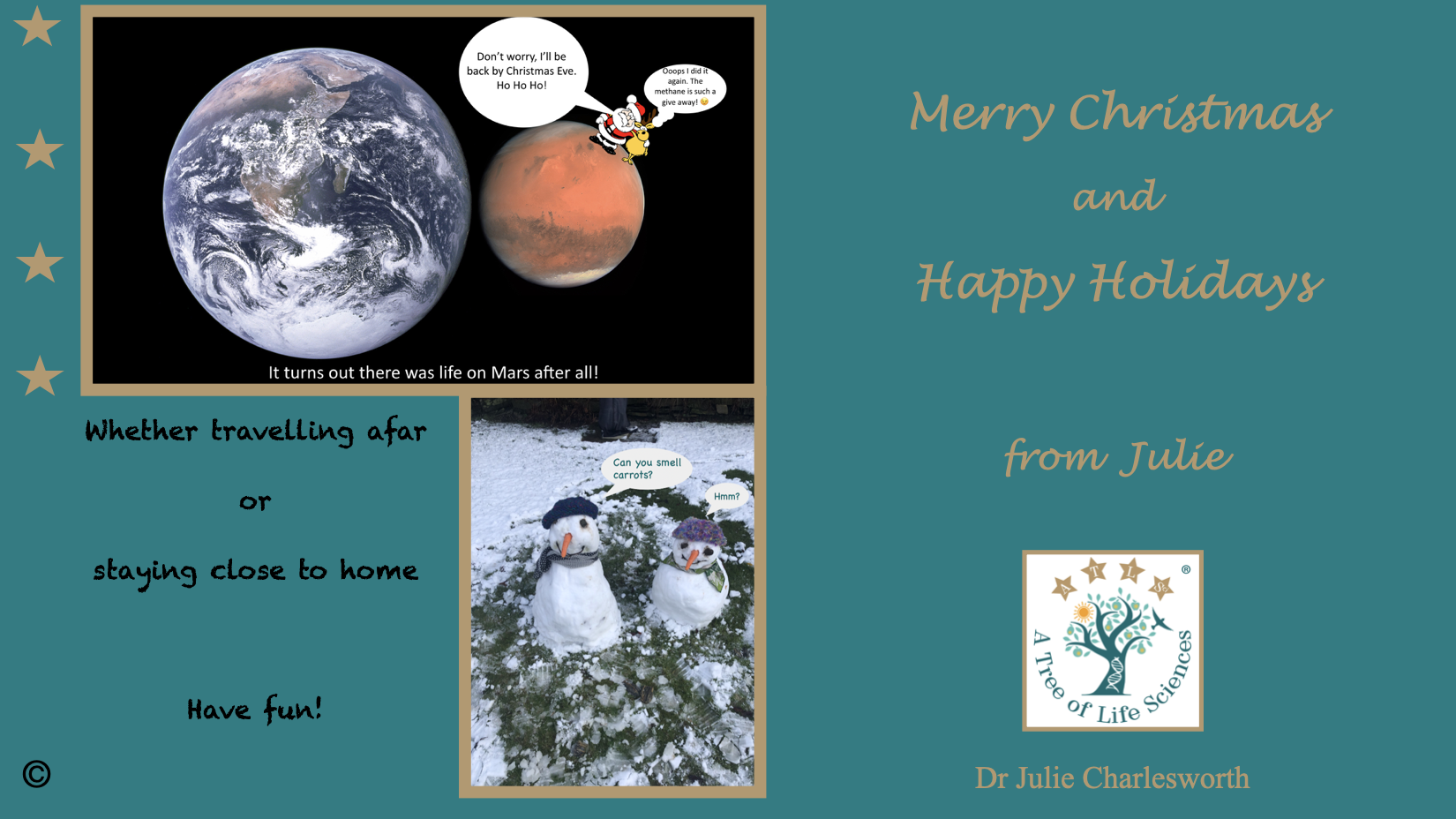
ATLSci Xmas card 2022

Season’s Greetings to one and all.
Ho Ho Ho 🤶.

by Dr Julie Charlesworth 12/12/22

December begins with a ‘trip down memory lane’.

A little ´trip down memory lane’ and a bright future ahead. Recently I had a catch-up meeting here with one of my mentees. This pub brought back fond memories of being my regular local pub in bygone years when I was a cancer researcher at the Christie*, so I took this quick snapshot for posterity. The meeting was very forward-looking though 😊.

RL Pub festive photo

A fitting photo for the run up to this festive time of year🎄.

by Dr Julie Charlesworth 01/12/22

.

[*The Christie NHS Foundation Trust, Manchester. One of Europe’s leading cancer centres.]

Science fun: Playtime, reflections, and illusions.

Half-term reflections and fun with my young grandchildren (fun for ’grown-up kids’ too). We took these photos at the Museum of Illusions in Dubai. I highly recommend a visit there.

Photos of JDC and Illusions taken at the Museum of Illusions

by Dr Julie Charlesworth 09/11/22

‘Jabbed to go’, proceeding with caution, and a trip to the UAE.

I have just arrived back from a few interesting, invigorating, and enlightening weeks in the UAE. This visit was primarily for an important personal family commitment in Dubai, but I was also making the most of the trip on many levels, some of general interest to me and some work-related. On the basis of ‘jabbed to go’- I did go but still proceeded with caution by having my 4th covid vaccine jab some 6 weeks ago (and the annual flu jab around the same time). The trip proved to be an excellent and productive experience.

More to come about this mini adventure…

Meanwhile, I have a few comments about proceeding with caution:

Having received NHS invitations for my 4th covid vaccine jab and seasonal flu jab I ensured I was booked in as soon as possible.


‘Jabbed to go’.

Mask wearing although required in some specific situations seems to be largely a matter for personal judgement these days. My experience in the UAE felt safe and reassuring. However, on arrival back in the UK seeing the packed airport arrival hall and extensive queuing of hundreds of unmasked people I immediately put a face mask on as a precaution. The staff were doing their best in difficult circumstances. Such situations at airports really need to be improved!

I am still feeling ‘picky’ about travel and events – making the most of any trip I do take and getting maximum value out of any event.

by Dr Julie Charlesworth 6/11/22

Looking forward: Life Science students and early career researchers.

Very best wishes to all those embarking on studies and research careers, particularly in life sciences and of course generally as well. How the world and humankind need you! How we should all be encouraging and supporting the younger research generation. For all those students and researchers driven by a passion for their subject it should be a time to really enjoy studying and research for the sake of research; a time to explore interests and have a great life and social life too. It’s not the easiest of times and research can be very frustrating with many ups and downs. It was ever thus. It is however an adventure with opportunities to grasp, whilst keeping a sense of perspective and having fun! Many of us are willing you on to a great future!

Looking forward…

The skills learnt will be transferable for many different career options. Early career researchers have much to contribute, and they deserve to be challenged, encouraged, and supported in their research careers. They also have so much potential in many walks of life and different spheres.

by Dr Julie Charlesworth 27/9/22

Summer reflections and perspectives.

Summer holidays are coming to a close for many people. On reflection I’ve had mainly a fun and productive summer, but I am conscious that it has not always been so for many people including myself, particularly recently. Looking back to a previous holiday earlier this year I share some photos I took capturing some different moods and moments over a period of a few weeks in the same place on a different holiday. We shouldn’t take things too much for granted in life or how other people are feeling.

Moods and Perspectives sea views

Here is another photo I took from my garden on return from my holiday back to the UK last weekend.
Rainbow and trees from the garden in the UK
(Photo capturing a moment on the evening of 18/9/22).

Behind many a photo lies an interesting story to tell…

To hope and optimism.

by Dr Julie Charlesworth 23/9/22