
The influence of working mothers – A few childhood memories of my working mum.

My mother worked part-time throughout most of my childhood and beyond. For many years she was the manageress of a small local launderette. I have very fond memories of her taking me to work which she did quite often. I loved it!

It was great fun helping with little tasks, and chatting to staff and customers who Mum knew. As a treat she’d send me to the bakers a few doors down the road to get potted beef, bread cakes, and iced finger buns.

Highlights:
• Cups of tea and lots of chat!
• ‘Cashing up’ – it was my job to put coins in little piles of equal value making is easier to tot up the total takings of the day.
• Being shown how to fold sheets – the easy way and more fun with a team of two.

Mum had an amazing head for numbers. I remember her totting up her shopping bill and knowing exactly how much she had spent before arriving at the till. Embarrassing as it was for me, it seemed she was often disputing discrepancies with shopkeepers or assistants, but she was always spot on and accurate!

When I had children, myself, she strongly encouraged me to continue work – preferably part-time even. Being a good mother and also having an independent spirit was important.

In her teens she was expected to go work ‘in t’ mill’ like other women in her family. She was more ambitious and preferred office work – rising to chief cashier at the local Woolworths, and training staff at other branches. Her own mother and some other family members thought her to be a bit too hoity toity. However, her dad saw potential in her and at some point-in-time she told me he had offered her money to get her started in her own business. She always regretted not having done so – she was afraid of losing his hard-earned money. (He was a Yorkshire coal miner, supporting a big family).

As was expected Mum gave up work immediately on getting married. I was her youngest child. As I recall she was working again (part-time) by the time I was about 4 years old.

It seemed fitting that I used some money Mum left to me, to set up my own business, in 2013.

When I had mentioned the idea a few years earlier, I remember her saying, ‘Wouldn’t you really like to run your own café?’

So, how did I become a scientist in cancer research and a specialist in Life Sciences? Well, that’s another story of many…

Nevertheless, I learned so much from my smart working-class mother. Her influence made me grounded but also ambitious in good ways, I think. We were similar and different, as well. She was not perfect, but because of that I think she was indeed perfect. I continued to call her and visit her frequently to the end, and always valued her straight talking and insightful advice. This piece touches on the influence of working mothers. Mum taught me many things, but I think her most precious legacy is her values.

We have the choice to emulate the best bits from our parents – and this is what I tell my own children. Mum was always telling me she was ‘very, very proud’ of me. I tell my children the same and use the same words.

by Dr Julie Charlesworth 21/03/23

.

[This post follows on from my previous ones on International Women’s Day and Mother’s Day 2023 in the UK.]

Fancy a cuppa tea? ☕️

Made in Manchester, but Yorkshire – born and bred 😊.

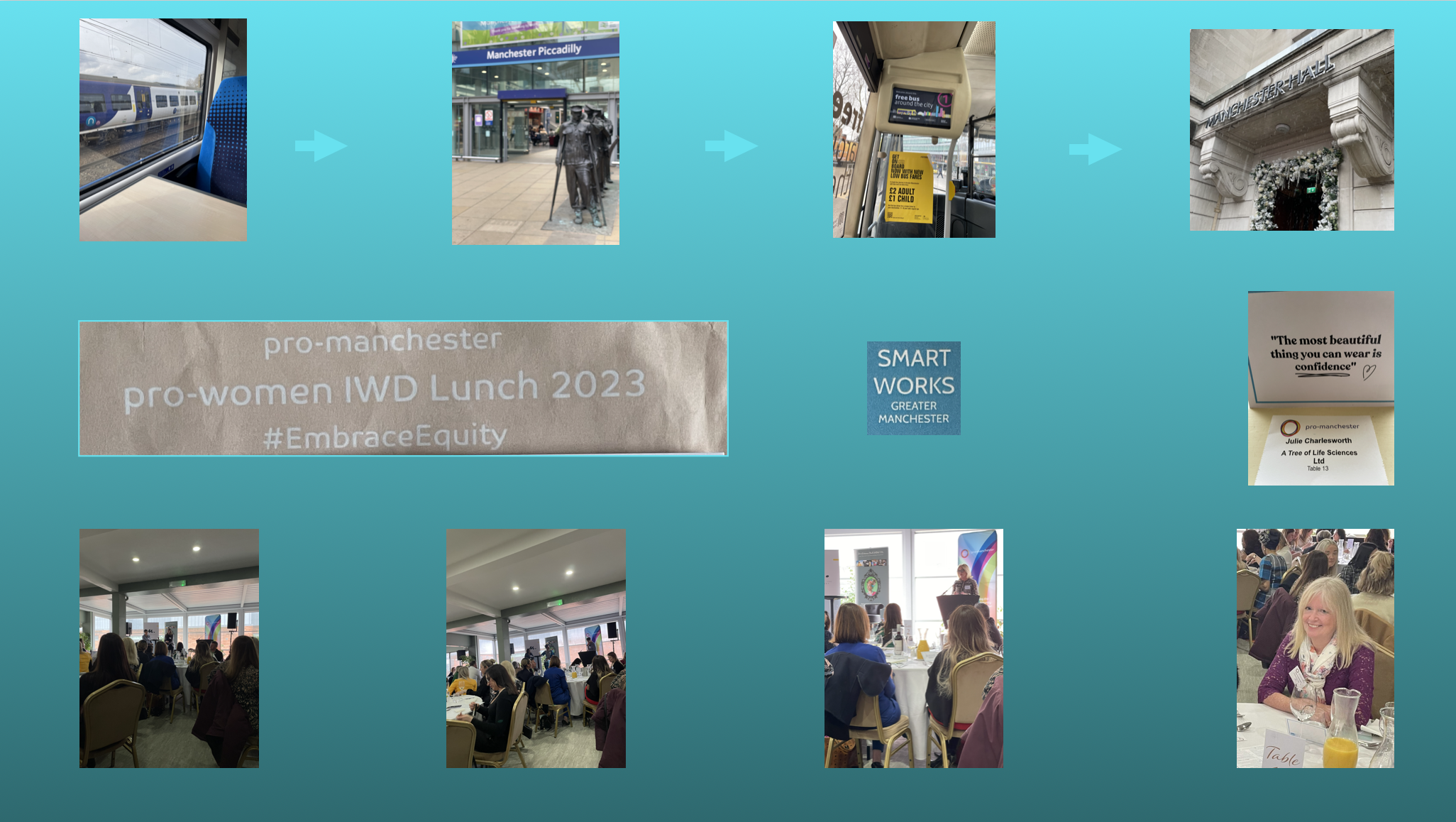
A pro-manchester event, in the UK on International Women’s Day (IWD).

I was delighted to have been invited to join some other Northern women on one of the 2 Women Leading in Business (WLiB) tables at an event with about 300 attendees (mainly women but some men too).

IDW 2023 pro-manchester event
My snapshots capture some moments in the day.

This involved a short train journey into the centre of Manchester.

Having arrived back in Manchester from Dubai just the night before, the weather felt distinctly chilly, but it was more than compensated by the warmest of welcomes from fellow women on International Women’s Day!

This was Manchester so the energy in the room was high for this celebratory event! The agenda addressed important issues of our time. There was a powerful and moving opening song by Rowetta. This was followed by some inspirational speakers and panel discussions highlighting the journeys of women and their successes in the face of considerable challenges. Discussions about current challenges evoked words of wisdom, resilience, empathy, determination, and unity.

Passion, straight-talking, and humour were in abundance in the networking opportunities. I met some familiar friends and many new faces. The general buzz of the event was in keeping with the Manchester worker bee (one of the best-known symbols of Manchester) representing a hive of activity and the sense of unity in this great city.

This pro-manchester event was sponsored by Menopause the Wright Way. Charity Partners were Smart Works and CARISMA.

I thoroughly enjoyed the day. Thanks to all the speakers, organisers, and those behind the scenes. A special thanks to Rachel Tetlow (pro-manchester programmes and events) and to Claire-Marie Boggiano (host of WLiB).

What a week!

I need some quiet time now to catch up on all the happenings and posts relating to International Women’s Day.

Here’s to all the amazing women in many different fields who I feel proud to know and to the very visible people and the quieter people all doing their bit in troubling times. I am feeling a sense of humility.

by Dr Julie Charlesworth 08/03/23

.

Click here for more about pro-manchester

A Tree of Life Sciences®: Consistency and a few surprises to come…

This is a quick and timely synopsis about A Tree of Life Sciences® to inform new connections, and to act as a quick reminder and an update for those already familiar with the company.

When I set up A Tree of Life Sciences Ltd some years ago, I created the name and designed the logo, myself. On reflection, I made the right decision particularly in view of the huge interest in life sciences and the research and endeavours that are being undertaken these days. I am very proud of the name and the logo which are registered trademarks (I protect them whenever necessary). My ideas are ‘often imitated but never equalled’ 😉.

Logo | A Tree of Life Sciences Ltd

Through these themes, I can continue to contribute to my mission to Inform, Improve and Inspire particularly in Life Sciences and health research; but also, in life and sciences more generally.

The website covers the potential scope of the company – the focus evolves and changes from time to time but the purpose remains clear and consistent.

Features include:

• Transcending borders and boundaries in subject and scope.

• Global, national, and local projects or perspectives.

• Project consultancy and communications including Life Sciences, Clinical and Health Research.

What a great time to be involved in research and communications!

Science is important, exciting and sometimes surprising. Scientists are serious about their work and often playful too.

My communications include papers, posts, and poems. The subjects are serious with a creative flair.

by Dr Julie Charlesworth 28/02/23

Focus on Purpose.

I am a scientist and I have a clear purpose. I am an expert in life sciences, clinical and health research. I am on a mission to Inform, Improve, and Inspire particularly in the Life Sciences. But also, in life and sciences more generally.

Remember ‘Not all those who wander are lost’.

I have a clear purpose.

A Tree of Life Sciences® exists to inform, improve, and inspire.

As a project consultant I ‘make it happen’ and I have been doing this for many years for the projects I have worked on or led.

A Tree of Life Sciences® continues to ‘make it happen’ as an independent consultancy and through its communications.

by Dr Julie Charlesworth 22/02/23


(‘Not all those who wander are lost’ from a poem by J.R.R. Tolkien.)

February Snow Moon: A glorious start.

I have just taken 2 snapshots to capture these moments: from my own back garden last night and from the front of the house early this morning.

I am looking Up from Earth – Up North in the UK.

February Snow Moon  from  home in the  UK

What a glorious uplifting start to February!

by Dr Julie Charlesworth 06/02/23

.

5 things I learned about in 2022, and a quick recap from ESOF2022.

Do you take the opportunities to listen and learn more about areas beyond your expertise?

Participating in international multidisciplinary conferences piques my curiosity to explore areas outside my own specialisms. Indeed, I have found that this is often how I get the most value out of such events.

The EuroScience Open Forum (ESOF) is top notch for this purpose. ESOFs are exemplary in their scope and what they achieve. I have previously reported back on every ESOF since 2016.*

Whilst I am ready to launch myself into 2023, January has also been a good time to recap and to add a few more highlights and take-home points from ESOF2022.

I think you may find some of my choices surprise you:

The Covid pandemic: featuring frequently in several discussions under different themes at ESOF2022

This pandemic is something we have all been through. At ESOF2022 there were success stories, concerns, answers to questions, and suggestions for the future. There were thought-provoking discussions relating to how much was achieved and how much more needs to be done.

We need to continue to ask 2 questions – What else are we learning? How can we best prepare for different pandemics and other global or local crises in the future?

Spectacular Science: High profile advances and things to watch out for

Artificial Intelligence (AI):
There were lots of discussions about recent advances, the enormous potential of use of AI, and some dilemmas for society. A key take home message for me was that we should also be aware of possible hype around the value and capabilities of AI.
As I said in a recent post on AI ‘we should proceed with optimism, but also with caution and with ‘eyes wide open’.

The Quantum Revolution:
It was interesting to hear further developments: some have been fast and some less so (such is science). I found the discussions very interesting and personally they also consolidated the big leap in my understanding of quantum technology which I have already shared in a previous post in 2021. During ESOF2022 we were warned to beware the possible hype around this subject. Nonetheless, it is certainly a potentially exciting area and one to keep an eye on!

Space Science the big uplifting breaking news with images from the JWST:
The excellent coverage at ESOF2022 prompted me to write about this in a previous post where I also share my learning and a few further thoughts from this moment in space science history.

Watch out for further news and developments in these three high-profile areas.
Beware the possible hype.
Enjoy the thrill and joy of science!

Frontier research and an example closer to my specialist area of life sciences

Antimicrobial Resistance (AMR) is a major concern facing humankind now and for the future. I have mentioned and written about this topic before (and will again). At ESOF2022 I participated in a fascinating session on AMR in which experts described new research, novel approaches and funding issues. It was a learning experience for me. I was excited about new approaches and the passion of the research leaders and early career researchers. On the other hand, it is frustrating to hear about funding issues and the compelling need still for companies to take these ideas and developments forward on a bigger scale.

The funding and support of basic research is very important! Curiosity driven research per se can ultimately contribute more than research driven by apparent business needs.

The whole ESOF2022 experience

My reporting has covered some selected areas that particularly struck a note with me this time. In addition to important scientific sessions there were topics and discussions relating to business, policies, current global issues (wars, climate). Indeed, it was ‘an exciting programme around seven themes: Sustainable Environment, Cultural Identities and Transformation, Space for Science, Healthy Societies, Freedom and Responsibility of Science, Science and Business and Sustainable Academic Careers.’ Thought-provoking comments made by other people often resonate, inspire or prompt action.

ESOF2022 participation has equipped me with knowledge and understanding that I hope will enhance my contributions in communication, consultancy, and career mentoring.

I have enjoyed reporting back from ESOF 2022 and more widely sharing some of my learning and my own thoughts in posts and even in verse.

Finally

Science is exciting – there are so many stories to tell…

by Dr Julie Charlesworth 31/01/23

.

_______

*For further information on my participation (in person or latterly on-line) at ESOFs:
Participation in ESOF2022 and a quick summary of my ESOF participation over the years.

A Moment in the History of Space Science: coverage at ESOF2022 and my thoughts now.

On July 12th, 2022, NASA (The U.S. National Aeronautics and Space Administration) released the first full-colour images from the James Webb Space Telescope (JWST).

The very next day the EuroScience Open Forum ran sessions at ESOF2022 to enable further explanation of the images, and to provide an understanding of the history of the JWST including the many different challenges and difficulties that had been successfully overcome. Sessions continued in Leiden and on-line throughout the week to enable questions, discussions, and debate amongst a wide range of scientists, politicians, and the public. Experts including astronomers, engineers, and other scientists were on hand to provide explanations of the science and the significance.

The excitement and enthusiasm were palpable. The speakers and discussions were inspirational to younger researchers, budding astronomers and more generally of course.

It was fitting to hold these sessions during ESOF2022 because in addition to the major role of NASA the success of this significant breakthrough was also a result of extensive international collaboration in which the ESA (European Space Agency) had a major involvement. *

I learned a lot about space science at ESOF2022 and I also realised how much I didn’t know. My curiosity was sparked, and this motivated me subsequently to go and find out more from other sources as well.

I would like to share some of my learning with you:

A few key points

The JWST enables us to look further back in time than ever before.

The reason why the JWST has been likened to a time-machine that lets us see into the past is that when looking at very distant objects we see them as they were in the past because the light takes time to reach us.

Infra-red (IR) astronomy is the key ‘game-changer’ to enable this breakthrough.

We were previously unable to see earlier galaxies and further back because they were invisible to us. Light that was emitted more than 13.5 billion years ago would be ‘stretched out’ finally arriving here as infra-red light.

Some of the science, engineering, and technological development involved

The JWST team had to put this large IR telescope into space because IR light is absorbed by water and our atmosphere is full of water.

An IR telescope needs to be cold; it is very sensitive to tiny amounts of heat. Therefore, the telescope needed to be a long distance from the Earth. However, it would then be in direct ‘line of fire’ of the Sun which is a massive source of heat.

A major challenge was that something had to be invented that would keep the telescope cold and ‘never let it see the Sun’. The solution was the invention of a unique mirror (6.5 meters in diameter) and ‘a sunshield the size of a tennis court’. This mirror had to be built on the ground to test that it would work. Both the mirror and sunshade needed to be folded up to be transported and to subsequently be unfolded far away in outer space.

Programme and project management

From my own experience in projects and consultancy (albeit not on this scale and in different areas) I am sure there will have been many challenges and learning to be taken forward from this large international, collaborative, inter-disciplinary programme. Important aspects would have included teamwork, leadership, planning and monitoring not to mention the politics and funding challenges that needed to be managed along the way.

I’d like to highlight the following points that immediately strike me regarding JWST:

1. The need for persistence: The story behind this programme sends a message of the power of persistence which led to ultimate success despite many challenges and setbacks on the way.

2. The importance of risk management. Attention to detail is key, for example what might seem like the smallest human error can affect the success of the whole project.

I also think this success story brings a message of hope to other individuals and groups when facing setbacks; emphasising the immense value of taking the learning forward when things go wrong or not exactly to plan.

Concluding remarks:

The JWST programme is great example of what can be done in science with collaboration, persistence, and support.

Big collaborative projects can work well and achieve enormous advances.

The JWST success sparks curiosity and prompts other questions to explore for example questions regarding the birth of stars, and even whether there is Life beyond Earth…

The world is watching this space for further discoveries to come (pun intended 😉).

Finally, it is very exciting because we are going to discover and see things we have never seen before!

by Dr Julie Charlesworth 27/01/23

_________

*The U.S. National Aeronautics and Space Administration (NASA) led JWST’s design and development and partnered with two main agencies: the European Space Agency (ESA) and the Canadian Space Agency (CSA).

Post Script. Here I share my perspective of this ‘out of this world’ news. I’ll soon be back in more familiar territory – Life Sciences and related 🧬, clinical and health research which I find equally exciting. However, as the new year begins it seems particularly timely to have a quick look back and even beyond 😊 🚀.

_________

At the EuroScience Open Forum in 2022 (ESOF2022)

Thoughts on Artificial Intelligence (AI).

Here are some of my thoughts just now on Artificial Intelligence (AI) generally.

The increasing use of AI can be a bit ‘mind-boggling’.

There is clearly an important and potentially valuable role for AI in many science and medical fields, and aspects of life in general. There is a great deal written about this subject elsewhere.

At the EuroScience Open Forum in 2022 (ESOF2022) there were some interesting discussions on dilemmas about AI in science and society. In some of the discussions I picked up on a couple of phrases and opinions which I found thought provoking:

• A suggestion that AI would be better called ‘augmented computation’.

• A suggestion (in July 2022) that when compared with human capabilities in some respects, for example in publishing, AI could be considered at the level of ‘the gifted toddler’. However, capabilities do seem to be rapidly increasing and this is resulting in current debate and news coverage.

• It is concerning that in some instances with the use of AI there are dangers of asking a system to do something that it is not designed to do, and also potentially locking in prejudices that are not transparent or immediately obvious to others.

It strikes me that AI is here to stay, and with it there is great potential for it to be used for the benefit of humankind. We are already reaping benefits. We should however be aware of the possible hype around the value and capabilities of AI.

There are reasons to proceed with optimism, but also with caution and with ‘eyes wide open’.

by Dr Julie Charlesworth 16/01/23

.

At the EuroScience Open Forum in 2022 (ESOF2022)

Looking Beyond in the lull before the New Year.

By looking beyond, I find I am often better able to understand and communicate what is in front of me. This could be my mantra 😊😉.

I am just popping in here to wish you well in this quiet period – the lull before the New Year.

by Dr Julie Charlesworth 27/12/22

.

[NB. I will shortly be sharing some thoughts and posts on some ‘beyond’ topics on which I am qualified to report and comment on more generally…

Of course I will continue to share and contribute in my specialist areas of Life Sciences, Clinical and Health Research]